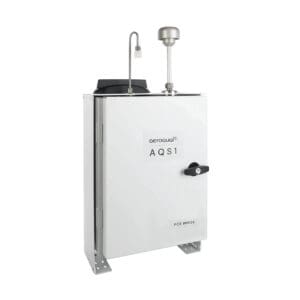
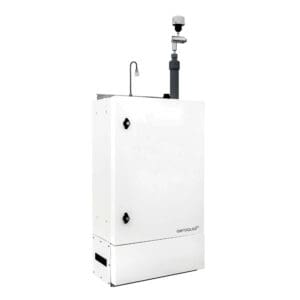
Volatile organic compounds are a group of compounds that can occur as gases in ambient air. Aeroqual’s VOC modules provide continuous measurements for perimeter monitoring, with low- and high-range options to suit different expected concentrations.
Volatile Organic Compounds (VOCs) is the name given to a group of organic compounds which can exist as a gas in the atmosphere.
VOCs are not listed among the six criteria health pollutants cited by the U.S. EPA. However, the effects of VOC exposure are becoming more understood and demands for ambient VOC monitoring are increasing.
Product Features
Specification
Low-range VOC
High-range VOC
Measurement technology
Photoionization detector – PID
Photoionization detector – PID
Measurement range
0-500 ppb
0-30 ppm
Display resolution
0.1 ppb
0.01 ppm
Lower detection limit
<1 ppb
<0.1 ppm
Precision
2% of reading or 1 ppb
2% of reading or 0.05 ppm
Noise: Zero; Span (% of reading)
<1 ppb; 1%
<0.1 ppm; 1%
Linearity (% of FS)
1%
2%
Drift 24 hour: Zero; Span (% of FS)
1 ppb; 1%
0.1 ppm; 1%
Monitor platforms
AQS 1 and AQM 65
AQS 1 and AQM 65
These are alternative module ranges, not a single selectable-range specification.
Performance & Field Data
Aeroqual reports R² = 0.99 in controlled multipoint gas tests for both ranges. Measurements are typically calibrated to isobutylene. Response varies by compound: the module does not identify individual VOCs, provide benzene-selective results or detect methane.
Results shown are from the specific manufacturer-reported evaluation described. Performance depends on the monitoring configuration, calibration, site conditions and measurement objectives.
Typical Applications
Remediation perimeter monitoring
Investigations around fuel- and solvent-related activities
Industrial VOC event assessment
Select the range and calibration approach for the anticipated mixture and project objectives.
Select the right module for your project
Tell Specto what you need to measure, the concentrations you expect and the monitor you plan to use. Our engineers and scientists can help you select the module, configuration and calibration approach for your project.