
Noise Monitoring in
North Carolina
Class 1 sound data for North Carolina's local noise codes.
North Carolina’s growth has made it one of the busiest construction markets in the country — EV and battery plants in the Triad, a life-sciences boom in the Research Triangle, and rebuilding across the west. North Carolina sets no statewide construction-noise limit, so the rule that applies comes from the city or county, and Charlotte, Raleigh, and Durham write the most detailed codes.
Specto equips North Carolina contractors and consultants with Class 1 monitoring stations that record around the clock, compute statistical levels like the L10, send alerts when a threshold is exceeded, and report automatically. Instead of assembling a system on site, your team installs a configured station and starts documenting conditions from day one — answering questions with data instead of recollection.
Regulatory
The Rules That Apply to North Carolina Projects
North Carolina has no statewide construction-noise limit. Requirements come from local ordinances and a few state and federal rules, so the governing standard depends on the city or county:
- Local ordinances set the limits — many North Carolina cities and counties base their limits on the L10 sound level (the level exceeded 10% of the time) and on the zoning of the receiving property, commonly protecting residential areas to around 55-60 dB(A) by day and lower at night
- Charlotte — measures sound with an ANSI-standard meter and sets dB(C) limits at the property line (85 dB(C) daytime, 60 dB(C) late night); repeat or “chronic” noise producers can be required to adopt a noise mitigation plan with self-monitoring
- Raleigh and Durham — Raleigh's 2024 ordinance limits construction to 7:00 a.m.–8:30 p.m. unless permitted, using a reasonable-person standard, while Durham sets 60 dB(A) daytime and 50 dB(A) after 11:00 p.m.
- Measurement basis — because many ordinances reference ANSI meters and L10 statistical limits, a Class 1 instrument that computes statistical levels directly is the right tool for a defensible measurement
- Federal and state rules — federal OSHA worker noise exposure requirements (29 CFR 1926.52) and FHWA 23 CFR 772 apply, alongside NCDOT requirements and project-specific permit conditions
Why North Carolina Teams Choose Specto
01
Ready to Deploy: US Inventory
Specto stocks Class 1 noise monitoring systems in the US for rent or purchase. Teams in Charlotte, Raleigh, Durham, Greensboro, and Asheville can have monitoring on site in days — before a concern turns into a delay.
02
Field-Ready: Configured Before Shipment
Each station arrives with alert thresholds, reporting schedules, and SvanNET remote access already set. Your crew installs and starts recording, instead of assembling a system on site.
03
Statistical Limits and Local Codes
Many North Carolina ordinances base their limits on the L10 statistical level and the zoning of the receiving property, and the rules differ between Charlotte, Raleigh, Durham, and smaller communities. Specto configures each station to the standard governing your site — computing L10 and other statistical levels directly — with automated reports built for agency and community review.
Who Uses Specto in North Carolina
We don’t replace consultants — we equip them. Common users include:
Environmental consultants
Acoustical and noise-vibration consultants
Construction managers and general contractors
NCDOT and federally funded transportation teams
Battery, life-sciences, and infrastructure project teams
The North Carolina Construction Landscape
North Carolina is one of the fastest-growing states in the country, and the building reflects it. Toyota’s $13.9 billion battery plant in Liberty has started production and pulled a wave of suppliers into the Piedmont Triad, the Research Triangle is in the middle of a life-sciences boom — Fujifilm’s plant in Holly Springs, Eli Lilly in Concord, and new campuses from AbbVie and Biogen — and Charlotte is adding a fourth runway at its airport. In the west, communities are rebuilding roads, bridges, and water systems after Hurricane Helene.
From massive manufacturing and pharmaceutical campuses to airport and recovery work, much of this construction runs close to homes and workers. Continuous monitoring gives North Carolina teams the data they need to document conditions, respond to concerns quickly, and keep work moving.
North Carolina Firms Working in
Noise-Sensitive Environments
North Carolina’s engineering, environmental, and construction community handles the projects where noise monitoring matters most. Firms active across the state include:
Stewart Acoustical Consultants
Raleigh
Independent acoustical consulting firm founded in Raleigh in 1979, providing architectural, environmental and community, and workplace noise-control consulting for building, outdoor, and industrial projects across the Carolinas and beyond.
Kimley-Horn
Raleigh
Raleigh-founded planning and design consulting firm and one of the largest in the country, providing transportation, civil, environmental, and land-development engineering for public and private clients nationwide.
S&ME, Inc.
Raleigh
Employee-owned engineering firm founded in Raleigh in 1973, providing geotechnical, environmental, civil, and construction-materials engineering and testing from offices across North Carolina and the Southeast.
WithersRavenel
Cary
North Carolina-based civil engineering, environmental, and geomatics firm serving municipalities, developers, and public agencies with infrastructure, water, and land-development services across the state.
McKim & Creed
Raleigh
North Carolina-based engineering and surveying firm specializing in water and wastewater, infrastructure, energy, and geomatics, serving public and private clients across the state and the Southeast.
McAdams
Raleigh
North Carolina land-planning and civil engineering firm with offices in the Research Triangle, Charlotte, and Durham, providing site design, land planning, geomatics, and infrastructure services for private development and public projects.
Working on a North Carolina project that needs noise monitoring? Specto supports consultants and contractors as a technology partner.
Recommended System for North Carolina Noise Monitoring
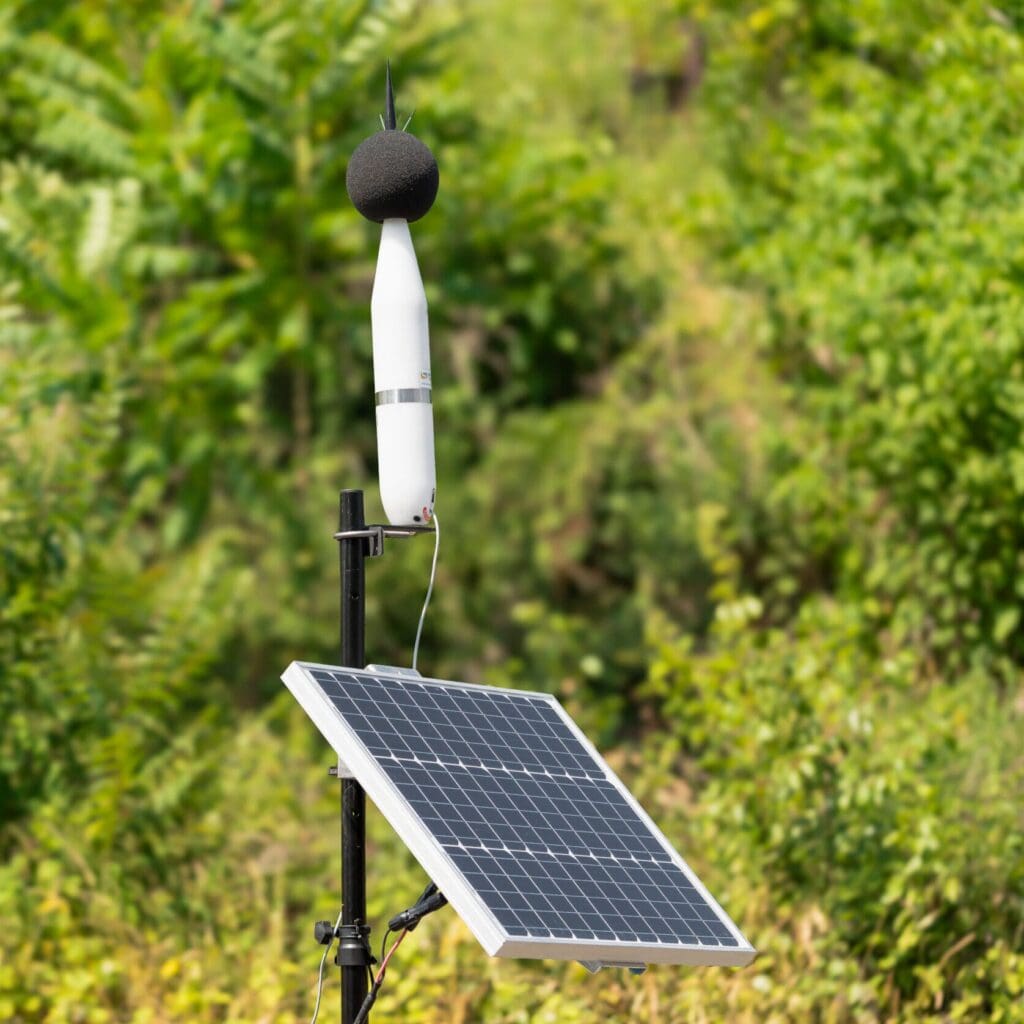
Svantek SV 307A Class 1 Noise Monitoring Station
Deploy once. Monitor for months.
Permanent Class 1 noise monitoring built for continuous outdoor deployment, with a patented dual-microphone system check that verifies the measurement path remotely.
Available to rent or buy from Specto's US inventory.
- Class 1 accuracy to IEC 61672-1:2013, with optional 1/1 and 1/3 octave analysis to IEC 61260-1:2014
- Noise statistics computed on the station — Ln (L1–L99), Lden, LEPd, two rolling Leq, and a complete histogram in meter mode
- Lifetime Svantek warranty on the patented MEMS microphone; three-year warranty on the instrument
- IP 54 housing rated from −20 °C to 60 °C, with 32 GB microSD storage upgradeable to 128 GB
- Patented dual-microphone system check, plus a built-in sound source producing approximately 100 dBA at 1 kHz for manual or automated verification
- Built-in 4G modem for SMS and email alarms, with results and configuration available through SvanNET
- Battery operation up to 6 days with the modem off and up to 5 days with it on, plus solar, AC, and external DC (10.5–24 V) power options
- Optional triggered audio recording and live audio streaming to support noise source identification
Our Methodology — How We Work With You
01
Discovery
We start by understanding the project, not by selling equipment. That means scope, timeline, and location; monitoring requirements and regulations; site constraints like power, connectivity, and access; and who needs the reports.
02
System Design and Preparation
We bring together the hardware, sensors, power and connectivity strategy, software setup, alerts, reporting, mounting, and accessories — then configure and prepare the system so it arrives ready for the field.
03
Delivery, Onboarding and Support
We support your team through deployment guidance, practical training, troubleshooting, reporting and alert support, and calibration and service coordination for the life of the project.
North Carolina Noise Monitoring — Common Questions
No. North Carolina regulates construction noise through local ordinances rather than a single statewide limit. Charlotte, Raleigh, and Durham have the most detailed codes — many North Carolina ordinances base their limits on the L10 statistical level and the zoning of the receiving property. Because the governing rule depends on where you're working, confirm the specific ordinance for your site with the authority having jurisdiction.
Yes. The SV 307A is a Class 1 sound level meter certified to IEC 61672 — closely aligned with the ANSI Type 1 specification many ordinances reference — and it computes statistical levels such as L10, L50, and L90 directly while logging A- and C-weighted sound at the same time. That makes it well suited to North Carolina's L10-based and dB(C) limits. For enforcement, confirm the exact standard the authority having jurisdiction expects.
Long deployments are where remote verification matters most. The SV 307A pairs a patented dual-microphone system check with a built-in sound source for manual or automated verification, so you can confirm the measurement path without a site visit, and data stays available through SvanNET for the life of the project. A built-in 4G modem sends SMS and email alerts the moment a threshold is exceeded.
Request Quote
For Sales, Rentals, and Quotes, please get in touch with us by filling out the form below. Our knowledgeable staff is ready and eager to assist you!